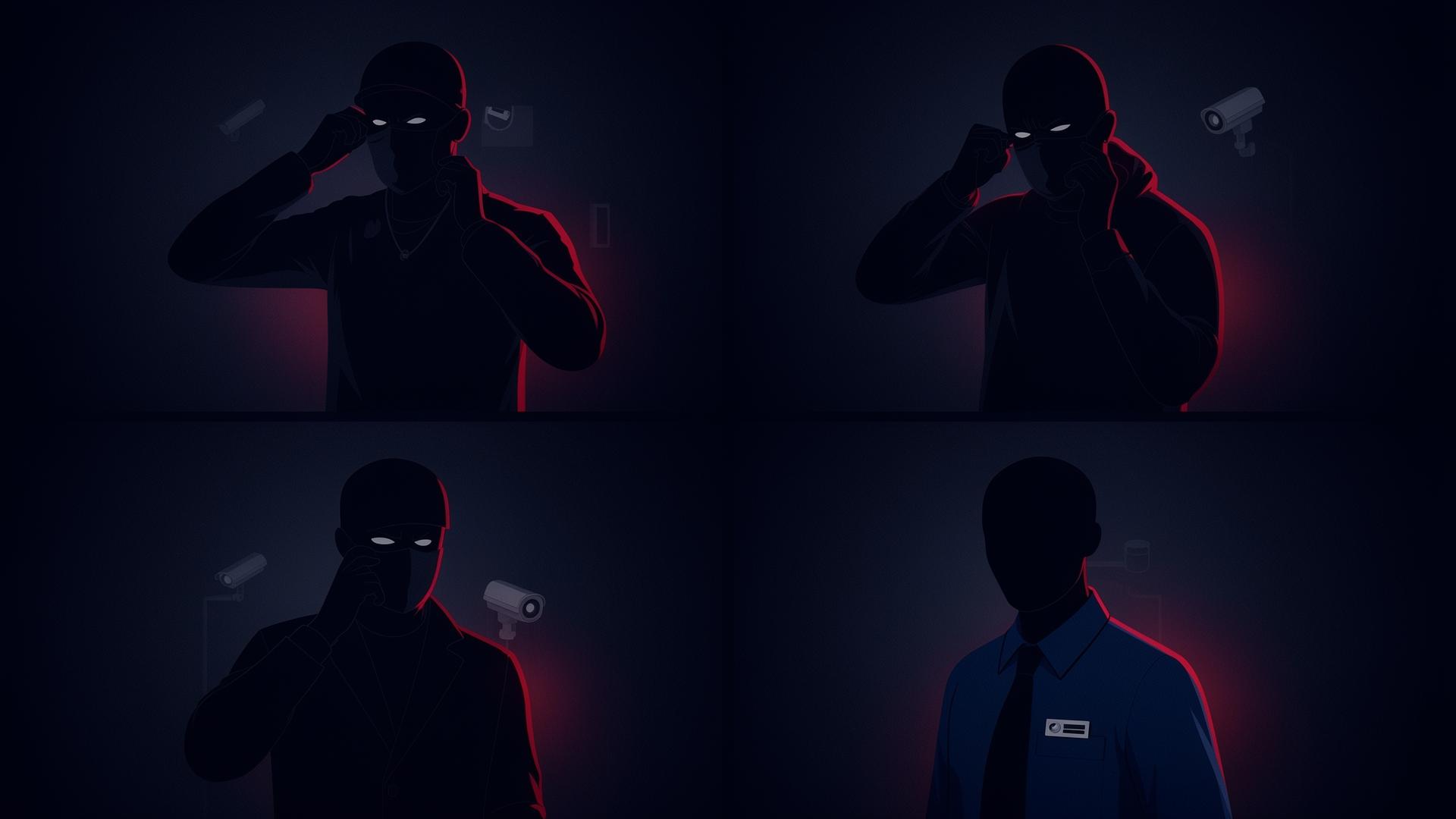
The four types of thieves at a glance
After investigating hundreds of cases, I have come to see almost every theft as one of four motivations. Here is the short answer, and then the field detail underneath it:
- 1. The Opportunistic Thief. Did not come in planning to steal. Takes what your conditions leave unguarded, based on one question — how likely is it I get caught?
- 2. The Necessity Thief. Driven by financial, chemical, or emotional pressure. Reasons about fairness rather than risk, which makes their risk tolerance unpredictable.
- 3. The Thrill Thief. Steals for the challenge of beating your system. The item is secondary; winning is the point.
- 4. The Insider Thief. Employees, managers, bookkeepers, vendors, and contractors who use trusted access. Rarely starts with theft — it starts with a tolerated small thing.
The reason the categories matter is practical, not academic. A control that stops one of them will not slow another one down, and a single one-size-fits-all response is how owners end up reacting to losses instead of preventing them. Everything below is the behavior, examples, and prevention detail for each type.
It takes a thief to catch a thief
Anyone who has spent time in this profession has heard the phrase. Usually from a manager who saw it on a movie poster. Sometimes from an owner who has just discovered that the most trusted person in the building has been stealing from them for two years.
"It takes a thief to catch a thief."
It is one of those sayings that sounds clever and means almost nothing on its face. Taken literally, it is wrong. Most of the best investigators I have worked with in over two decades of this work have never stolen a dollar in their lives. What the phrase is really getting at — and what most people miss — is the part nobody quotes: you do not have to be a thief to catch one, but you do have to understand how one thinks.
That is the entire job. Not catching. Understanding.
Catching is what happens at the end. Understanding is what happens every minute of every day before that. It is what tells you which door is the easy one. Which cashier is being groomed. Which vendor rep is testing your back door. Which procedure has rotted out from the inside without anyone noticing because the same person has been responsible for it for six years.
Investigation looks backwards at what already happened. Prevention looks forward at what almost did.
Most small businesses spend nearly all of their energy on investigation — reports, exception logs, shortage reviews, year-end inventory variances. Those tools matter. But they are autopsies. By the time the numbers tell you something is wrong, the loss has already happened, the goods are already gone, the cash is already spent, and the person responsible has often already moved on.
Prevention is a different exercise entirely. It starts with one uncomfortable question:
If I wanted to steal from this business, how would I do it?
When an owner can sit with that question honestly — without defensiveness, without "my people would never," without the assumption that the cameras and the alarm and the trusted manager are enough — they begin to see the business the way a thief sees it. And that is the first time real prevention becomes possible.
To do that well, you need to understand that a thief is not just a thief. There are different kinds. They think differently. They target different things. They expose different weaknesses. They leave different fingerprints. A control that stops one of them will not even slow another one down. After investigating hundreds of cases — internal, external, and the messy ones in the middle — I have come to think about almost every theft in terms of four core motivations.
Understand these four, and you will start to see your business the way a professional loss prevention practitioner sees it.
1. The Opportunistic Thief
The opportunistic thief is the most common type of thief any business will ever encounter, and the one most owners underestimate. They are not professionals. They did not wake up that morning planning to steal anything. They walked into your store to buy laundry detergent and a soda. The opportunity is what created the theft — not the other way around.
Motivation and mindset
The opportunistic thief is driven by one calculation, made in seconds: What is the chance I get caught? Not "do I need this," not "is this right," not "what if I get caught" — but simply, "how likely is it?" If the perceived risk is low enough, the moral barrier collapses almost instantly. Most people who would never plan a theft will quietly take advantage of one that is practically gift-wrapped.
Internally, the justification is almost always one of three things:
- "It's just one item. They won't even miss it."
- "They left it sitting right there. That's on them."
- "Look at this place — they're making plenty."
Notice that none of those statements have anything to do with wanting the item. They are statements about the environment. That is the hallmark of opportunistic theft. The trigger lives in the store, not in the person.
What creates the opportunity
Walk through your business with this checklist and you will see every opportunistic theft you have ever had — and many you do not yet know about:
- An unattended register drawer left slightly open between transactions.
- High-value merchandise stacked on an end cap with no camera coverage and no employee sightline.
- Tools, knives, batteries, or razors on open shelves near a side exit.
- A back door propped open during deliveries with nobody actively watching it.
- A bathroom located past unsold merchandise with no employee acknowledgment on the way in.
- Self-checkout lanes monitored by one tired attendant during a rush.
- Fitting rooms with no item count going in or coming out.
- Returns processed without managers, without ID, and without the original receipt.
Each one of those is an invitation. The opportunistic thief did not build the opportunity. You did.
How they select a victim — and how they look while doing it
Watch them long enough and the behavior is almost always the same. They are not nervous. They are not hiding. They are scanning. They are checking sight lines, checking for employees who look up when the door chimes, checking for cameras with active red lights, checking for mirrors. They are reading your store the way you should be reading them.
Typical behaviors:
- Slowly walking the perimeter of the store before approaching any specific aisle.
- Picking up an item, looking around, putting it back, repeating.
- Avoiding eye contact with staff, especially after being acknowledged.
- Lingering in blind spots — corners, end caps facing away from the counter, back corners.
- Carrying bags, jackets, or purses that are inconsistent with the weather or the shopping pattern.
- Asking an employee a long, distracting question about a product on the opposite side of the store.
- Returning to the same area more than once without selecting anything.
None of these prove anything on their own. Honest people scan too. Honest people wear coats in summer. Honest people ask questions. The discipline is in noticing clusters, not single behaviors.
What employees should do
The single most effective opportunistic-theft countermeasure ever invented is acknowledgment. A clear, friendly, eye-contact greeting within ten seconds of someone entering the store will end a meaningful percentage of theft attempts before they begin. The opportunistic thief was hoping to be invisible. You just made them visible.
Teach staff to do the following:
- Greet every customer by name when possible — "Welcome in" is fine if the name is unknown.
- Offer help a second time when a customer doubles back into the same aisle.
- Reset shelves and recover the sales floor constantly — a tidy store is a watched store.
- Walk the floor on a routine, not a schedule, so timing is unpredictable.
- Never confront — observe, document, and escalate.
Why this is the most preventable thief
The opportunistic thief is the easiest type to stop because their decision-making is entirely dependent on conditions you control. Change the conditions, and you change the outcome. The same person who would have taken a $30 item from your unwatched aisle will not take it from an aisle where they were greeted, offered help, and feel observed. You did not change them. You changed their calculation.
2. The Necessity Thief
The necessity thief is the most uncomfortable type to talk about, because every honest person reading this knows that under the right kind of pressure, the moral line gets thinner for almost everyone. This is the parent who walks into a grocery store with twelve dollars and a hungry kid, the addict whose calculation has been rewired by withdrawal, the elderly customer on a fixed income who cannot decide between food and the prescription. None of those situations excuse the act. All of them shape the behavior.
Motivation and rationalization
The necessity thief is driven by pressure — financial, chemical, or emotional — that overrides their usual self-image. They are typically not career criminals. They are people who, under normal circumstances, would never consider taking anything. The rationalization sounds like this:
- "I'll pay it back later."
- "I just need to get through this week."
- "This store can absorb it — I can't."
- "It's just food. It's just diapers. It's just medicine."
Notice that the rationalization is moral, not logistical. The opportunistic thief reasons about chances. The necessity thief reasons about fairness. They are not asking whether they will get caught — they are asking whether the act is forgivable. Once they have answered that question for themselves, the risk calculation matters less than it should. That is what makes the necessity thief unpredictable. Their tolerance for risk is artificially elevated by desperation.
Behavioral and emotional indicators
The necessity thief looks different from the opportunistic one. Where opportunists scan and stay loose, necessity thieves carry visible weight. The body is tense, not casual. The eyes drop, not roam. The movement is purposeful rather than wandering. They are not enjoying being in the store.
- Tight, hurried movements with a clear destination.
- Avoiding eye contact in a way that reads as shame, not avoidance.
- Selecting essentials — food, baby items, hygiene products, OTC medication.
- Visible signs of financial or physical distress (worn clothing, exhaustion, illness).
- Children present and aware, which can complicate decision-making in both directions.
- Concealment that is fast and clumsy rather than practiced.
What works — and what does not
Traditional deterrents (cameras, signage, security audits) work less reliably on the necessity thief because their decision is not primarily fear-based. What works more consistently is presence and engagement. An employee who walks the aisle, says hello, asks if they need help finding anything, and lingers nearby will resolve a large percentage of these incidents quietly — sometimes by simply reminding the person that they have been seen.
Long-term, businesses that have visible community partnerships (food banks, local assistance programs, posted resource numbers at the customer service desk) experience measurably less necessity theft. That is not soft policy. That is loss prevention. You are offering a path that is easier than stealing.
How managers should respond
Train managers to handle these situations with composure. The necessity thief is rarely a flight or fight risk. They are usually embarrassed. The right response is private, calm, factual, and consistent with policy — never humiliating, never escalating, never public. The moment a manager turns one of these incidents into a spectacle, the store loses far more reputation than it lost in merchandise.
3. The Thrill Thief
The thrill thief is the one that experienced investigators secretly find the most interesting and the most underestimated. They are not stealing because they need anything. They are not stealing because the opportunity is too easy to resist. They are stealing because the act itself is the reward.
Motivation: the game, not the goods
For this thief, the value of the merchandise is almost irrelevant. I have interviewed thrill thieves whose closets at home were full of unopened items still bearing the security tags. They could not always tell me what they had taken last week. They could always tell me, in vivid detail, exactly how they had taken it.
The motivation cluster looks like this:
- Challenge — "Can I beat this system?"
- Ego — "I'm smarter than this store."
- Power — "They have no idea I'm in here."
- Adrenaline — the physical rush of getting away with it.
- Game mentality — the store is a level to be beaten, and the staff are NPCs.
This is the one type of theft where the merchandise is, in the thief's own mind, almost a trophy. The act is the point. Which is why this thief is the most dangerous to a complacent operation — they are looking for the very thing complacent operations broadcast without realizing it.
How they study your store
Thrill thieves surveil. They do not "happen by." They case. They return. They test. Long before they take anything significant they are doing reconnaissance, and that reconnaissance is observable if anyone is watching.
- Repeated visits at different times of day to map staffing patterns.
- Triggering small alerts (touching tagged merchandise, lingering near sensors) to watch staff response time.
- Asking detailed questions about return policies, camera coverage, or staffing schedules in ways that feel innocent on the surface.
- Buying small, low-value items to build a "regular customer" identity.
- Photographing or filming inconspicuously — phone in hand, screen pointed at fixtures.
These behaviors are why patterns matter more than individual moments. A single visit means nothing. The same person on three Tuesdays in a row, always during shift change, always lingering in the same corner, is data.
Why they exploit predictability
Predictability is the thrill thief's oxygen. Every routine you repeat without variation is a piece of intelligence handed to them for free. If your manager always counts the safe at 2:00 PM, they know when the cash is unattended. If the back door is always propped at delivery time, they know your blind window. If the same cashier always works Sundays alone, they know your soft target. The more disciplined your routine, the more vulnerable your routine is — unless you intentionally introduce variation.
Consistency in standards. Randomness in execution. That is the sentence that disrupts thrill theft more than any single camera or policy ever will.
Disrupting the game
Practical countermeasures that actually work on this profile:
- Randomized till audits — not scheduled, not predictable, not always by the same person.
- Rotating coverage in high-risk aisles so the same blind spots are not blind at the same time every day.
- Unannounced floor walks by a manager from another location.
- Calling out the obvious: greeting suspicious patterns directly with a friendly "Back again — how can I help?" The thrill thief wants to be invisible. Being recognized ruins the game.
- Quietly tracking repeat visits with timestamped notes (license plate, time in, time out, behavior observed) — never confronting, just documenting.
4. The Insider Thief
Now we come to the one that costs small businesses more than the other three combined.
The insider thief is not standing on the wrong side of the counter. They are standing on yours. They have a key. They have a login. They have the trust of the owner, the friendship of the team, and the kind of operational familiarity that takes outsiders years to build. They do not have to defeat your systems. They areyour systems.
In two decades of investigations, the single most consistent sentence I have heard from owners after an insider case is closed is some version of this: "I would have bet my life on that person." Insider theft is so devastating not because of the dollars — which can be staggering — but because of what it does to the owner's ability to trust again.
Who is included in "insider"
Many owners hear "insider" and think only of cashiers. That is a narrow view. The category includes:
- Cashiers and floor employees.
- Shift leads and assistant managers.
- General managers, especially long-tenured ones with sole control of cash, inventory, or scheduling.
- Bookkeepers and back-office personnel.
- Vendor and DSD (direct store delivery) reps who restock and self-report.
- Outside contractors with after-hours access (cleaning crews, IT, refrigeration techs).
- Family members and longtime friends who are "helping out."
Anyone with trusted access is a potential insider. Trust is the access mechanism — not the keycard.
The motivation cluster
Insider theft rarely starts with theft. It starts with a feeling. The feeling almost always falls into one of these:
- Entitlement. "I work harder than anyone here, and I deserve this." Often appears after a missed raise, a denied promotion, or a perceived slight by ownership.
- Resentment. "They treat me like I'm replaceable. Fine." A grudge becomes a justification.
- Financial pressure. Debt, divorce, gambling, medical bills, child support. The pressure builds; the access is right there.
- Addiction. Substance, gambling, or compulsive spending — a relentless cash demand that has to be fed somewhere.
- Lifestyle creep. A standard of living that has quietly outgrown the paycheck.
- Workplace grievance. A specific incident — discipline, demotion, an argument — that flips a long-stable employee into a justified one.
Insider theft is almost never the first dishonest act. It is the eighth. The first seven were small enough that nobody pushed back.
The slow slide — how good employees become insider thieves
Almost no one wakes up one day and decides to start stealing from the company that employs them. The process is gradual and almost always follows a pattern an experienced investigator can recite from memory:
- Stage 1: A small rule violation that gets ignored — eating from inventory, taking a "damaged" item, clocking in five minutes early.
- Stage 2: A larger rule violation that gets explained away — voiding a friend's transaction, comping a coworker's lunch, giving a "courtesy" discount.
- Stage 3: A theft of low-value cash or merchandise, often framed internally as "borrowing."
- Stage 4: A pattern. The behavior is no longer rationalized event by event — it is normalized.
- Stage 5: Discovery, often during inventory, audit, or because the person finally took something too obvious to miss.
The point an owner needs to take from that timeline: stage one is where prevention lives. Once you are dealing with stage five, you are no longer preventing — you are documenting and recovering.
Behavioral warning signs
Insider behaviors are subtle and almost always read as "personality" until they are taken together. The clusters that matter:
Personality and trust shifts
- An employee who suddenly becomes defensive about routine questions.
- A long-tenured employee who begins isolating themselves — eating alone, avoiding the manager's office, declining to train others.
- Mood shifts that do not match what is happening on the floor.
- Increased irritation at audits or oversight that they previously had no problem with.
Control and ownership behaviors
- Insistence on being the only person who does the deposit, the schedule, the receiving, or the inventory count.
- Refusing days off, especially around inventory or audit cycles.
- Working unpaid extra hours that always coincide with cash handling or back-office tasks.
- Resisting cross-training "because it's easier if I just do it."
- Discomfort when someone else covers their shift unexpectedly.
Operational and transaction patterns
- Disproportionate voids, refunds, no-sales, or post-voids tied to one user.
- Consistent small over/short patterns on the same drawer.
- Refunds without product return, or refunds processed on closed-out tender types.
- Discount or coupon usage that always falls on the same employee's transactions.
- Receiving discrepancies that get "corrected" by the same person.
- Inventory counts that consistently improve on the days a specific person is off.
Lifestyle indicators
- New vehicle, new electronics, new jewelry — without a clear explanation that fits known income.
- Frequent vacations, dining patterns, or expensive habits inconsistent with role and pay.
- Casual mentions of large purchases that do not square with what the business pays them.
Every single one of these has innocent explanations. A new car could be a co-signer. A vacation could be a relative. A defensive moment could be a bad day. The discipline — and it is a discipline — is to document everything and act on patterns, never on single observations.
How businesses unintentionally create insider theft
Owners almost never see this part clearly. The same conditions that make a small business feel like a family — informality, trust, autonomy, "we don't need to count it twice" — are the exact conditions that create insider opportunity. A few of the most common self-inflicted vulnerabilities:
- One person owns the deposit, the count, and the bank trip.
- The same manager schedules themselves alone for opening and closing.
- Inventory is counted by the person responsible for protecting it.
- Receiving is done unaccompanied by the person who also processes vendor invoices.
- Refund and void permissions are granted to everyone "to keep things moving."
- Cameras exist but are never reviewed unless something has already gone wrong.
- Audits are scheduled, predictable, and conducted by the same person every time.
- Long-tenured employees are exempt from procedures applied to everyone else.
Every item on that list is fixable. None of them require new equipment. Most of them require nothing more than the willingness to apply the same standards to your best people that you apply to your newest ones.
Prevention strategies for insider theft
- Separation of duties. No single person owns cash, inventory, or vendor relationships end to end.
- Mandatory cross-training. Anyone whose absence breaks a process is a vulnerability — to the business and, frankly, to themselves.
- Random, unscheduled audits. Tills, safes, voids, refunds, and high-risk SKUs.
- Two-person controls. Deposits, safe access, and large refunds always require two signatures or two presences.
- Consistent policy enforcement. The same rules apply to the owner's cousin, the longest-tenured manager, and the brand-new cashier.
- Visible, used cameras. Reviewed weekly on a schedule — not only after a loss.
- Documented coaching trail. Small rule violations are addressed in writing, every time, calmly. This is how stage one stays stage one.
- Exit controls. Resignations trigger immediate access changes — keys, codes, logins, vendor accounts.
Why understanding behavior matters more than catching thieves
Anyone can catch a thief eventually. Cameras catch them. Audits catch them. Year-end inventory catches them. The much harder, more valuable, and more profitable skill is recognizing the conditions that produce them — and dismantling those conditions before anything has to be caught at all.
That is what separates investigation from prevention, and it is what separates loss prevention as a function from loss prevention as a mindset.
Behavior vs. assumption
Most owners run on assumption. "My people would never." "We have cameras." "Nobody's stealing — I'd know." These statements feel like knowledge but function like sleep. They are the cognitive equivalent of locking your front door and leaving the back one open because you are not facing that direction.
Behavior is the opposite. Behavior is observable, documentable, and pattern-based. A trained eye does not ask, "Is this person a thief?" That is an unanswerable question and a dangerous one. A trained eye asks, "What is this person doing, and how many other things am I seeing that match?"
Clusters, not snapshots
One nervous customer is nothing. One missing item is nothing. One large refund is nothing. Three together, on the same day, by the same person — that is something. Six together, over three weeks, in the same department — that is a case. Loss prevention thinking is cluster-based, not snapshot-based. Owners who learn to think in clusters spot problems weeks earlier than owners who react to single events.
How rationalization actually works
Almost no one steals while believing they are a thief. The psychological mechanism is called neutralization, and it is textbook in criminology. The brain insists on coherence between action and self-image, so when behavior crosses a line, the brain rewrites the line.
- "I'm not stealing — I'm borrowing."
- "I'm not stealing — I'm owed this."
- "I'm not stealing — they can afford it."
- "I'm not stealing — everyone does it."
- "I'm not stealing — the policy is stupid."
Owners who understand this stop being shocked when "good people" do dishonest things. There is no such thing as a perfectly honest person under any pressure. There are only people whose environment has not pushed them past their own line yet. The job of loss prevention is to design environments that do not push people there in the first place — and to detect the early signs when an environment has begun to do so.
Why theft rarely starts with theft
This is worth repeating because it is the single most important thing a small business owner can internalize: theft almost never starts with theft. It starts with a tolerated small thing. A cashier eating from open inventory. A manager taking the deposit bag home overnight "just this once." A vendor rep being allowed to count and report the same SKUs they deliver. None of those things are theft. All of them are the soil that theft grows in.
Show me an operation that ignores its small rule violations and I will show you an operation that has a large rule violation coming.
A challenge for business owners
Close the laptop. Put down the phone. Walk into your business tomorrow morning before anyone else gets there, and walk through it slowly with one question in your head — and only one.
If I wanted to steal from this business, how would I do it?
Be honest. Brutally honest. This is not a moral exercise; it is a diagnostic one. If the answer comes to you in less than thirty seconds, you have already learned more about your operation than most owners ever do.
Look for the things you have stopped seeing:
- The unattended register drawer between rushes.
- The back door that nobody really watches during deliveries.
- The high-value SKU on an open shelf with no camera.
- The refund policy that has not been reviewed in three years.
- The vendor who counts their own delivery and writes the receiving sheet.
- The trusted manager who has done the deposit alone for eight years.
- The cash drawer the bookkeeper "balances themselves to save you time."
- The cameras that nobody ever actually pulls footage from.
- The audit that always happens on the second Tuesday of the month.
- The new hire who was never trained on why the policies exist, only how to do them.
Every one of those is a thief's opportunity dressed up as your normal routine. None of them require an outsider to exploit. All of them only require nobody to be paying attention.
This is not about distrusting your people. The best loss prevention practitioners in the country are some of the most trusting human beings I know personally — because they have built environments that make trust safe. Trust without verification is not virtue. It is exposure. Trust with verification is what allows a small business to grow, scale, and survive the eventual day when one person makes one bad decision.
Pressure-test your own systems before someone else does. That is the entire ethos of professional loss prevention. We do not wait for losses. We hunt the conditions that produce them.
Where to take this next
Reading about the four types is the easy part. Closing the conditions they rely on is the work. If you only do one thing this week, start with the type your operation is most exposed to:
- Print the field reference. The 4 Types of Thieves warning signs and prevention guide collects every indicator and control from this article into a printable manager's reference.
- Close the register gap. Learn how to properly conduct a random till audit — the single control that most often interrupts insider cash theft at stage one.
- Learn the early signals. The five warning signs of employee theft owners miss and this deeper look at internal theft in retail both expand on the insider section above.
- Protect what gets targeted first. A high-risk merchandise tracker tells you which items to count more often than the rest of the shelf.
- Run the controls in one place. My LP Portal exists to be the loss prevention department small businesses never had — audits, incident documentation, coaching records, and trackers in one system. You can see what plans include when you are ready, and start free if you would rather try it than read about it.
If all you wanted was the education, you already have it. Nothing above requires software — only the willingness to apply the same standards to your best people that you apply to your newest ones.
Closing thoughts
Four types of thieves. Four motivations. Four sets of warning signs. Four sets of vulnerabilities they exploit. If you take only one thing from this entire article, take this:
A thief is not a thief. They are a behavior, a motivation, and an opportunity arriving in the same place at the same time. Remove any one of those three, and the theft does not happen.
You cannot change human nature. You will not eliminate desperation from the world, you will not make every employee immune to temptation, and you will not stop the next thrill-seeker from walking through your door looking for a game. What you can do — what professional loss prevention has always done — is close the opportunities. Light the dark corners. Watch the patterns. Listen to your own operation the way an adversary would.
The owners who do this work do not get to brag about catching thieves. They quietly stop having them. That is not luck. That is the discipline of seeing your business through the eyes of someone who would harm it — and refusing to leave them anything to work with.
Walk your store tomorrow. Ask the question. Write down what you see. Then come back to this guide, pick one of the four types, and start closing the door on them this week.
That is prevention. Everything else is paperwork.
A printable, 8–12 page field reference covering every warning sign, behavioral indicator, and prevention control discussed in this article — built to live in a manager's binder, not a textbook.
Frequently asked questions
What are the four main types of thieves a business should worry about?+
Opportunistic thieves who take advantage of weak controls in the moment, necessity thieves driven by financial pressure or desperation, thrill thieves who steal for excitement and the challenge of beating a system, and insider thieves — employees, managers, and vendors who exploit trust and access. Most cases an owner will ever encounter fall into one of these four motivations.
Why does motivation matter more than the act of theft itself?+
Because motivation drives behavior, and behavior is what you can actually observe and prevent. A thrill thief and a necessity thief may take the same item, but they expose completely different weaknesses in your operation. Once you understand why a person steals, you can predict what they target, when they act, and which controls will actually stop them.
Which type of theft is most common in small business?+
Across the small businesses I have investigated, insider theft causes the largest dollar losses, while opportunistic theft is the most frequent. Insiders have access, trust, and time. External thieves have to bring all of that with them. The combination of trusted employees and weak operational controls is where most serious small-business loss originates.
Can you really prevent theft, or just react to it?+
You can prevent the majority of it. Most loss is not the result of a sophisticated criminal — it is the result of an environment that quietly invites the behavior. Better procedures, visible accountability, consistent audits, and a culture that treats small rule violations as serious are what stop theft before it ever becomes a case.
Does understanding a thief's motivation excuse the behavior?+
No. Understanding motivation is not justification — it is intelligence. A doctor does not excuse cancer by understanding how it spreads. A loss prevention professional does not excuse theft by understanding how it develops. The point is to recognize patterns earlier and protect the business and the honest employees inside it.
Related reading
- 5 Warning Signs of Employee Theft Small Business Owners Miss
- Most Employee Theft Starts With Behavior, Not Missing Inventory
- Employee Theft Usually Starts With Process Failure
- You Don't Have a Theft Problem — You Have a Visibility Problem
- How to Coach and Document Operational Errors That Cause Loss
- How to Properly Conduct a Random Till Audit
Run all of this inside one place
My LP Portal turns checklists, audits, incidents, and trackers into a single working system — built for small business owners. Free to start.